Universitas Budi Luhur Unggulan di Jakarta

Campus Hiring : PT.Linknet (First Media,Tbk.)

Universitas Budi Luhur, bekerjasama dengan PT.Linknet (First Media,Tbk.) menyelenggarakan campus hiring (recruitment) pada :
Hari, tanggal : Senin , 19 Nopember 2012
Jam  : 09.00 WIB – Selesai
Tempat  : R 633 – Universitas Budi Luhur
Agenda : Interview, Psikotest
Peminat dapat mengirimkan surat lamaran, CV dan foto melalui email : karir.budiluhur@gmail.com
Catatan :
- Wajib registrasi via email dengan mengirimkan CV dan kelengkapannya
- Beri subject email : kode_lowongan_yang_dilamar
Contoh : Melamar posisi Call Center Officer, maka kode emailnya : LINKNET-CCO
- Paling lambat sebelum hari Minggu,  18 Nopember 2012 Jam 12.00 WIB
- Harap membawa surat lamaran lengkap saat datang psikotes dan wawancara, dengan melengkapi berkas:
1.Surat lamaran Lengkap
2.CV / Daftar Riwayat Hidup Lengkap
1).Call Center Officer (Kode : LINKNET-CCO)
Responsibilities:
•Handling customers complain and give good service
Requirements:
•Male / Female, maximum 30 years old
•Min Diploma 3 or S1 degree (fresh graduate are welcome to apply)
•Strong communication and interpersonal skill
•Computer literate (MS Office and internet application)
•Able to work in shift and/or during holidays, and willing to extend working hour
•Able to understand and speak English
•Persuasive and target oriented
•Able to manage emotional restrain & capable in handling complaint with empathy
•A good team player but able to work independently
•Willing to be place at Karawaci Office
2). Retention Officer (Kode : LINKNET-RO)
Responsibilities:
•Handling customers request discconect  account
Requirements:
•Male/Female min. 23 – 30 years old
•Minimum Diploma degree (D3) in any major
•Have excellent communication with customer & target oriented
•Computer literate
•Analytical thinking
•Fluent in English both written and oral
•Willing to be placed at karawaci office

Campus Hiring : PT. Sumberdaya Dian Mandiri

Universitas Budi Luhur, bekerjasama dengan PT. Sumberdaya Dian Mandiri menyelenggarakan campus hiring (recruitment) pada :
Hari, tanggal :Kamis , 22 Nopember 2012 (update)
Jam  : 09.00 WIB – Selesai
Tempat  : R 633 – Universitas Budi Luhur
Agenda : Interview, Psikotest
Peminat dapat mengirimkan surat lamaran, CV dan foto melalui email : karir.budiluhur@gmail.com
Catatan :
- Wajib registrasi via email dengan mengirimkan CV dan kelengkapannya
- Beri subject email : kode_lowongan_yang_dilamar
Contoh : Melamar posisi Frontliner (Customer Service dan Teller), maka kode emailnya : SDM-Frontliner
- Paling lambat sebelum hari Rabu, 21 Nopember 2012 Jam 12.00 WIB
- Harap membawa surat lamaran lengkap saat datang psikotes dan wawancara, dengan melengkapi berkas:
1.Surat lamaran Lengkap
2.CV / Daftar Riwayat Hidup Lengkap
3.Fotocopy Ijasah dan Transkip Nilai terakhir
4.Pas Photo 4 x 6 berwana sebanyak 2 lembar
5.Photo seluruh badan berwana sebanyak 1 lembar
6.Fotocopy KTP yang masih berlaku
7.Fotocopy SIM C
8.Fotocopy SKCK
9.Fotocopy sertifikat pendukung lain (training, surat pernah bekerja, kursus) jika ada
PT. Sumberdaya Dian Mandiri adalah Perusahaan yang bergerak di bidang Manajemen Sumber Daya Manusia yang berskala Nasional, Membutuhkan Tenaga-tenaga Untuk mengisi posisi :
1.Frontliner (Customer Service dan Teller) – Kode : SDM-Frontliner
Kualifikasi:
•Pria / Wanita
•Usia maksimal 25 tahun
•Pendidikan minimum D3 dari semua disiplin ilmu
•Memiliki jiwa melayani orang lain
•Berpenampilan Menarik
•Tinggi 165cm (pria), 155cm (wanita)
2.Administration  – Kode : SDM-Administration
Kualifikasi:
•Pria / Wanita
•Usia maksimal 25 tahun
•Pendidikan minimum D3 dari semua disiplin ilmu
•Menguasai Microsoft Office
•Memiliki jiwa melayani orang lain
•Tinggi 165cm (pria), 155cm (wanita)
3.Sales Person  – Kode : SDM-Sales Person
Kualifikasi:
•Pria / Wanita
•Usia maksimal 35 tahun
•Pendidikan minimum SMU ( Berpengalaman min 1 thn ) / D3 dari semua disiplin ilmu
•Memiliki kendaraan bermotor dan memiliki SIM C
•Memiliki jiwa melayani orang lain
4.Call Center – Kode : SDM-Call Center
Kualifikasi:
•Pria / Wanita
•Usia maksimal 26 tahun
•Pendidikan minimum S1 dari semua disiplin ilmu
•Bersedia bekerja secara shift
•IPK min 2,75
•Diluar pengalaman Marketing / Telemarketing
5.IT Support – Kode : SDM-IT Support
Kualifikasi:
•Pria
•Usia maksimal 25 tahun
•Pendidikan D3-S1 dari TI, SI, MI
•Mampu berkomunikasi dengan baik
•IPK min 2,75
6.Dispatcher – Kode : SDM-Dispatcher
Kualifikasi:
•Pria
•Usia maksimal 20-35 tahun
•IPK min 2,75
•Pendidikan D3-S1 dari berbagai displin ilmu
•Mampu berkomunikasi dengan baik dan berpenampilan menarik
•Mampu mengendarai mobil dan SIM A aktif
•Mampu mengkordinasikan pekerjaan


Universitas Budi Luhur Unggulan di Jakarta

Tgl 16 November 2012 Seluruh Akademik DILIBURKAN

Diberitahukan kepada seluruh mahasiswa Universitas Budi Luhur Fakultas Teknik bahwa berdasarkan pengumuman No. N/UBL/REK/000/07/11/12 tentang hari Kamis, 15 November 2012 merupakan libur nasional dalam rangka memperingati Tahun Baru Hijriah.
Sesuai dengan Surat Keputusan Bersama (SKB) tiga menteri pada hari Jumat, 16 Nopember 2012 merupakan Cuti Bersama, maka pada hari Jumat tanggal 16 November 2012 seluruh kegiatan akademik DI LIBURKAN.


Universitas Budi Luhur Unggulan di Jakarta

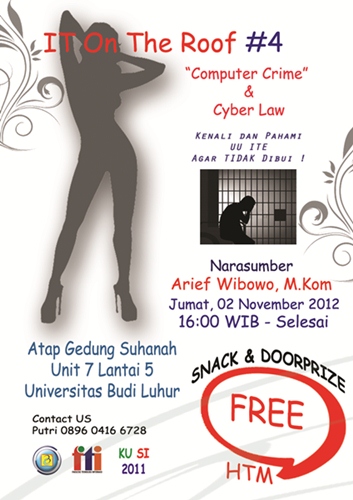
IT on the Roof Edisi #4: [Computer Crime & Cyber Law] KENALI DAN PAHAMI UU ITE AGAR TIDAK DI BUI

IT on The Roof merupakan satu kegiatan yang diselenggarakan dalam rangka memberikan pengetahuan mengenai perkembangan dunia teknologi informasi dan komputer bagi civitas akademika Universitas Budi Luhur , serta menciptakan iklim akademis (academic atmosphere) yang baik diantara dosen dan mahasiswa Fakultas Teknologi Informasi, Universitas Budi Luhur. Kegiatan yang digagas oleh Fakultas Teknologi Informasi ini, akan diselenggarakan secara rutin setiap 5 (lima) pekan sekali, tepatnya setiap hari Jum’at Kliwon. Mengusung konsep yang unik dimana acara diselenggarakan di atap gedung, tepatnya gedung Suhannah.
Edisi ke-4 akan diselenggarakan pada hari Jum’at, 2 November 2012 pukul 16.00 s/d selesai dengan temaKenali dan Pahami UU ITE Agar Tidak di Buiyang akan disampaikan oleh Bapak Arief Wibowo, M.Kom (Direktur Akademi Sekretari Budi Luhur dan Dosen Fakultas Teknologi Informasi Universitas budi Luhur).
So, buat temen-temen yang pengen ikutan gabung buat nambah ilmu, wawasan, teman baru sekalian bersilahturahmi, buruan mendaftar, karena tempat terbatas.
Pendaftaran Gratis + Snack
cp. 0896 0416 6728
Organized by KU-SI2011 Universitas budi Luhur


Universitas Budi Luhur Unggulan di Jakarta

Kunjungan Mahasiswa FTI Universitas Budi Luhur Unggulan di Jakarta ke BATAN
Pada hari Selasa, 23 Oktober 2012, mahasiswa FTI dan FT Universitas Budi Luhur Unggulan di Jakarta diberikan kesempatan langka untuk mengadakan kunjungan ke BATAN (Badan Tenaga Nuklir Nasional).
Dalam kesempatan ini, kurang lebih 60 mahasiswa Universitas Budi Luhur Unggulan di Jakarta dari berbagai prodi mendapatkan seminar singkat tentang BATAN,  dilanjutkan dengan kunjungan ke Reaktor Serba Guna GA. Siwabessy (RSG-GAS) yang memiliki daya thermal max 30 MW. 
pemaparan tentang institusi BATAN  pemaparan tentang institusi BATAN 
Mahasiswa mendengarkan pemaparan tentang institusi BATANMahasiswa mendengarkan pemaparan tentang institusi BATAN 
Pemberian cinderamata Budi Luhur kepada pihak BATAN Pemberian cinderamata Universitas Budi Luhur kepada pihak BATAN 
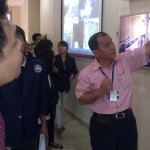
Tour ke Reaktor Serbaguna GA. Siwabessy Tour ke Reaktor Serbaguna GA. Siwabessy 
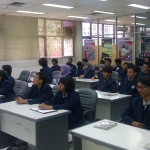
 mahasiswa mendengarkan pemaparan struktur jaringan ICT di BATAN mahasiswa mendengarkan pemaparan struktur jaringan ICT di BATAN

Universitas Budi Luhur Unggulan di Jakarta, Ciledug

Seleksi Beasiswa BBM & PPA

Setiap tahun Universitas Budi Luhur Unggulan di Jakarta, selalu mengadakan beasiswa BBM dan PPA yang dibantu oleh Kopertis Wilayah III.
Bagi mahasiswa universitas budi luhur unggulan di jakarta, dapat mengikuti atau berpatisipasi dalam ajang beasiswa ini, dengan mengikuti syarat-syarat berikut ini :

 Beasiswa Bantuan Belajar Mahasiswa (BBM), Universitas Budi Luhur Unggulan di Jakarta
1.  Mengajukan Permohonan kepada rektor Universitas Budi Luhur.
2. Terdaftar/aktif sebagai mahasiswa Reguler, dibuktikan dengan Fotokopi KTM dan fotokopi Kartu Rencana Studi (KRS) atau yang sejenis.
3. Fotokopi transkrip nilai dengan Indeks Prestasi komulatif (IPK) paling rendah 2.50 yang disahkan oleh pimpinan perguruan tinggi
4. Fotokopi rekening listrik bulan terakhir atau bukti pembayran Pajak Bumi Bangunan (PBB) dari orangtua/walinya
5. Fotokopi Kartu Keluarga
6. surat pernyataan sedang tidak menerima beasiswa dari sumber lain pada waktu yang sama, diketahui oleh Direktur Kemahasiswaan, Karir dan Alumni
7. Surat Keterangan Kelakuan Baik dari Pimpinan Fakultas/Program Studi
8. Surat keterangan tidak mampu atau layak mendapat bantuan yang dikeluarkan oleh Lurah/Kepala Desa
9. Calon penerima BBM ditentukan melaluii hasil seleksi yang dilakukan oleh Tim Seleksi Beasiswa yang dibentuk dan diangkat berdasarkan keputusan Rektor Universitas Budi Luhur

 Beasiswa Peningkatan Prestasi Akademik  (PPA), Universitas Budi Luhur Unggulan di Jakarta
1.  Mengajukan Permohonan kepada rektor Universitas Budi Luhur.
2. Terdaftar/aktif sebagai mahasiswa Reguler, dibuktikan dengan Fotokopi KTM dan fotokopi Kartu Rencana Studi (KRS) atau yang sejenis.
3. Fotokopi transkrip nilai dengan Indeks Prestasi komulatif (IPK) paling rendah 3.00 yang disahkan oleh pimpinan perguruan tinggi
4. Fotokopi rekening listrik bulan terakhir atau bukti pembayran Pajak Bumi Bangunan (PBB) dari orangtua/walinya
5. Fotokopi Kartu Keluarga
6. surat pernyataan sedang tidak menerima beasiswa dari sumber lain pada waktu yang sama, diketahui oleh Direktur Kemahasiswaan, Karir dan Alumni
7. Surat Keterangan Kelakuan Baik dari Pimpinan Fakultas/Program Studi
8. Surat keterangan penghasilan orang tua/wali pemohon san disahkan oleh yang berwenang
9. Fotokopi piagam atau bukti berprestasi lainnya (kokulikuler atau ekstra kulikuler) yang diselenggarakan Kemdikbud dan atau organisasi lain baik tingkat Nasional, Regional maupun Internasional
10. Calon penerima PPA ditentukan melalui hasil seleksi yang dilakukan oleh Tim Seleksi Beasiswa yang dibentuk dan diangkat berdasarkan keputusan Rektor Universitas Budi Luhur

Toshiba Says Goodbye To Netbooks in USA

Liliputing reports that Toshiba America has no plans to release new netbooks here in the States. An unnamed Toshiba executive confirmed that the company will instead focus on pumping out ultrabooks like the Portege Z830 series. Ultrabooks offer a thin and light form factor, but feature superior performance and a heftier price tag than netbooks.
At one time Toshiba was one of the more popular netbook manufacturers with enthusiasts. This was mostly due to its large, easy to use keyboards. Toshiba has manufactured netbooks for a number of years and may still sell the devices internationally. Case in point: The Toshiba NB510 revealed at CES 2012. This netbook features an Intel Atom N2600 Cedar Trail processor but won't be released here.

Toshiba is likely pulling out of the netbook race locally because sales just aren't there. Consumers are flocking to tablets and, as of late, ultrabooks. Currently rivals Acer, HP and Asus are still releasing the low-end portable systems, but Dell and Lenovo have officially pulled out of the local netbook market. Sony and Samsung still haven't launched a new model this year.
Overall, netbook shipments are down 34-percent from last year and now account for about 5-percent of global PC shipments. Looking ahead, they may soon be wiped off the face of the PC sector, replaced by low-end ultrabooks. Because Intel reportedly won't lower Ivy Bridge CPU prices, manufacturers are compromising by throwing in cheaper Sandy Bridge CPUs, swapping out SSD for HDDs, and using cheap batteries. This class will likely be a bit pricier than netbooks, but the tradeoff is better performance. For those looking for something in the netbook price range, these models will be far easier to tolerate budget-wise than the pricier high-end $800+ ultrabooks.

Apple: Leading the Way in Enlightened 'Corporate Empathy'?

A recent article by Gizmodo journalist Sam Biddle pointed out the emphasis on empathy in the training of Apple's Genius staff. Whilst we can look at the sales of the most successful company in the world and point to the fact that empathy-training works, this issue brings up another question of how far 'walking a mile in someone else's shoes' should extend in a corporate or retail environment.

Can it truly be said that Apple has managed to cultivate a culture of empathy? Or is it a case of simply using the language of empathy as a form of "nice wash" to guide a happy customer to a cash register?

To stand in your customer's shoes is the bedrock of excellent customer service -- would we want that to change? Absolutely not. But there's something deeper here. The reason empathy works in this context is because at the heart of this interaction is something very human -- being heard. That's the way we feel cared for. That's the way we shift our perspective, and gain insight into the hopes, aspirations, needs of each other, and respond accordingly. This transcends a commercial interaction, and creates a social bond unlike any other.

Here's where we need to get more insightful about the power of empathy and the way it works to transform corporate culture.

Top business strategist, Dev Patnaik in his book Wired to Care describes the human brain as an apple. His analogy is quite simple -- at its center is a hard core -- responsible for all the "reptilian" functions which ensure our biological survival -- hunger, our sex drive, and even contains the most primitive of all emotions: fear. On the outer core is the neocortex, responsible for our so called higher-level thinking. In mammals like mice, this part is thin but humans it's up to 80% grey matter, which is what makes us smart.
In between these two regions is the limbic system, which Patnaik describes as the "sweetest part of the apple" which draws together all the parts of the brain to handle emotional information. It's what is responsible for our capacity for empathy allowing us to communicate and sense emotional cues, which are fundamental to what makes us social and caring. It's in fact triggered by face to face interaction.
In corporate structures, Patnaik describes how companies are like "corporate iguanas -- ethically neutral beasts, focused on self-preservation." In other words, they can act and think, but can't feel. Is it any wonder that the legal personhood of a corporation has a mind (directors) and a body (shareholders) but no soul/emotion? In fact, their sole social responsibility according to economist Milton Friedman is to maximize profit for its owners (feed the body).
Our entire global economy has been shaped around this single form of human organization. Every single business person is taught to create the conditions of survival of the fittest for the corporate structure with the single measure of progress being financial data. As Patnaik states, when we turn up for work we leave half our brains at the door and we chime into the mantra - "nothing personal, it's just business."
For many of us, this means we're existing day to day in a man made structure, which denies a fundamental part of our nature as human beings. No wonder it's confusing.
In this age of hyperconnectivity, we're seeing now that business is becoming very personal. We're seeing the people behind the corporate veil. We're seeing the CEO as a person through blogs, Twitter and Facebook. We're seeing the very real people who make the products we buy. And in turn we're seeing the power of the collective and openly heard consumer voice affecting the bottom-line.
The fact is corporations are now a pervasive part of our lives. Today, 59% out of the world's 150 most powerful economic entities are corporations, not countries. Corporations create the conditions for survival for many.
Craig Davis, former Global CCO of J Walter Thompson, and founder of BrandKarma, a groundbreaking startup which rates brands behavior in the marketplace, sums it up:
"Companies are massively powerful, many of them have more economic muscle than entire countries and exercise massive influence on the world. With that comes a great responsibility to look into the impacts that they are having on communities, cultures and the physical environment. Good, sustainable businesses need to have an eye across all these impacts and be comfortable with the lens of transparency and accountability that technology brings to their stakeholders. Everything's on the record and there's nowhere to hide. Comfortable or not, companies have to put themselves in other people's shoes."
Is it any wonder, that with the level of corporate transparency that trends such as citizen journalism have demanded in recent times, these powerful structures which govern our lives are now discovering the "limbic" parts of themselves? This is especially the case when companies have the ugly side of their operations brought to light. The challenge for any CEO now more than ever is to ensure that any potential fall out is managed with integrity, authenticity, and preferably a human face.

Take the example of Unilever. A social media campaign led by Greenpeace in 2008, resulted in Unilever, the world's largest consumer of palm oil becoming a major force in the preservation of South East forests where they source the palm oil. By the end of 2012 it will reach its target of 100% certified sustainable palm oil covered by Green Palm Certificates. Going one step further, Unilever has now set a new target of purchasing all its palm oil from traceable sources by 2020. This is a perfect example of how one CEO's empathy enabled his organization to become a force for good sustainable practice, and lead the entire industry along the way.
In engaging with consumers, emotionally and socially directly via social media channels, today's companies are learning to expect a very human response to their actions. Thalidomide manufacturer Grunenthal's CEO, Harald Stock, experienced this first-hand recently. His late apology to mothers of children deformed by the drug Thalodmide after 50 years, was explained as some kind of delayed "silent shock." Mothers' reactions to Stock's "silent shock" excuse was understandably charged. To them, silent shock is when your child is born without limbs, from an unsafe drug, and an apology 50 years too late. Nevertheless, the fact is that Stock was prepared put a human face to claim corporate responsibility. Some would say a step in the right direction, albeit awkwardly.
How far does corporate empathy have to go? For corporations to navigate the new forms of social responsibility demanded of them by consumers, regulators, even shareholders, "corporate empathy" must this now expand to include the entire supply chain? From employees on the shop floor, to the upper echelons of management, right through to the workers in the factory making the devices? Ostensibly, it can be argued outsourcing does not mean outsourcing responsibility, nor reserving empathy for the sales team to be applied solely as means of sales conversion.
This is a key issue we investigate in an upcoming documentary about empathy, Stand in My Shoes, directed by Kurt Engfehr (Bowling for Columbine; The Yes Men; Fat, Sick and Nearly Dead).
We want to understand if it is indeed possible to have "enlightened corporate empathy" in a globally interconnected world. We've started looking at our favorite brands. When we first heard of the reports about Apple manufacturer Fox Conn's workers committing suicide on account of poor working conditions, like many we were troubled.
We've since seen in the last 6 months organized protests by social change organizations such as Sumofus.org demanding an "ethical iPhone". In 2010-2012 Apple submitted to numerous audits and as a result, developed a strategy to take action. We're curious as to why they're not broadcasting this good news to the high-heavens as much as the release of a new iPhone 5. Instead, this information relegated to an obscure part of their website, seemingly placed out of consumers sight.

We're hoping still that Apple becomes the leader of a movement amongst the entire manufacturing industry. It takes the might of such an economic entity to really have any influence with its suppliers, especially who dominate manufacturing like Fox Conn.

The next obvious question is how far down the supply chain does corporate empathy extend? The so-called "conflict minerals" for example, which create the electronic gadgets we love have an equally dramatic story of their own. Conflict minerals are those raw materials which are sourced from countries with extremely poor human rights records such as the Democratic Republic of Congo. Although many electronics companies have refused to accept conflict minerals in their manufacturing process, many are also not troubled by the difficulty in identifying which source materials with questionable origins. After all, most consumers are not aware of the story surrounding conflict minerals -- so why should the companies care?
Ultimately, this example highlights the inequalities in a complex global economic system - where desperation of failed states such as the Congo, seeking investment in their regions can find themselves aligning with market interests of the more unscrupulous players. This puts more ethical companies advocating for change at a competitive disadvantage. The casualties are sadly the human players at the very bottom of the chain, whose suffering inadvertently underpins the entire global economy.
We empathize with Apple. They have strove to be innovators, and clearly understand the language of empathy in customer service. But should they be required take it to the next level along the supply chain? Maybe its a question of cleaning up one step at a time.

Perhaps for an enlightened corporate empathy to operate at this global scale, there is not just a need for authenticity, but also corporate courage. Big business and governments have to be brave enough to create conditions for a fairer, more sustainable global system, which places human as well as economic well-being at the center.

There are signs of this happening.

We're certainly seeing a new generation of business leaders who are creating new models from the get go. TOMs Shoes founder Blake Mycoskie is a shining example. His 'One for One' movement -- one shoe given away to a child in need for every one sold -- has proven to be enormously profitable whilst improving the lives of many in the developing world. It's also given the company generous amounts of social capital. One feeding the other.

Yet others advocate that "good business" simply isn't enough and that we need to fundamentally alter the corporate structure itself to embrace this shift in values. If we continue to make 'bottom line' the entire measure of corporate empathy, no matter how much we dress up our corporate culture with nice feel good language, the outcomes will always remain the same.

"Benefit Corporations" (also known as "B Corps") however, are a new type of corporation in the U.S., which uses the power of business to solve social and environmental problems.

B-Corps are very different from a standard LLC. They are required to have a corporate purpose to create a material positive impact on society and the environment. They also have an expanded fiduciary duty to require consideration of the interests of workers, community and the environment in their decisions. Finally, they must publicly report annually on overall social and environmental performance against a comprehensive, credible, independent, and transparent third party standard. Could the B corp be sowing the seeds of genuine empathy within the DNA of the corporate structure?

Considering we create the systems, the cultures and the conditions of corporate structures - we are ultimately responsible for their evolution as individual entities. The success of the B-Corp is a step in the right direction. Apple stepping up to take a leadership position on the ethical standards of electronic industry supply chains, is another.

The challenge of our time is to create enlightened corporate empathy in an age our survival depends on our ability to thrive as a global tribe.
Our film, Stand in My Shoes, examines this tension and the conflicts and obstacles which stand in the way of truly empathic civilisation. Our aim is to also unearth new paradigms for business to develop their very own "limbic system", leading the way toward our sustainable collective future.
For now, it starts with a small step called authentic corporate empathy. And perhaps a few good apples can make it happen.
Stand in My Shoes, directed by Kurt Engfehr (Bowling for Columbine; The Yes Men; Fat, Sick and Nearly Dead) is a crowd-fueled social change film examining the "empathy deficit" of our times, and what the world's most influential "social revolutionaries" are doing about it.